Shark Teeth Identification Guide
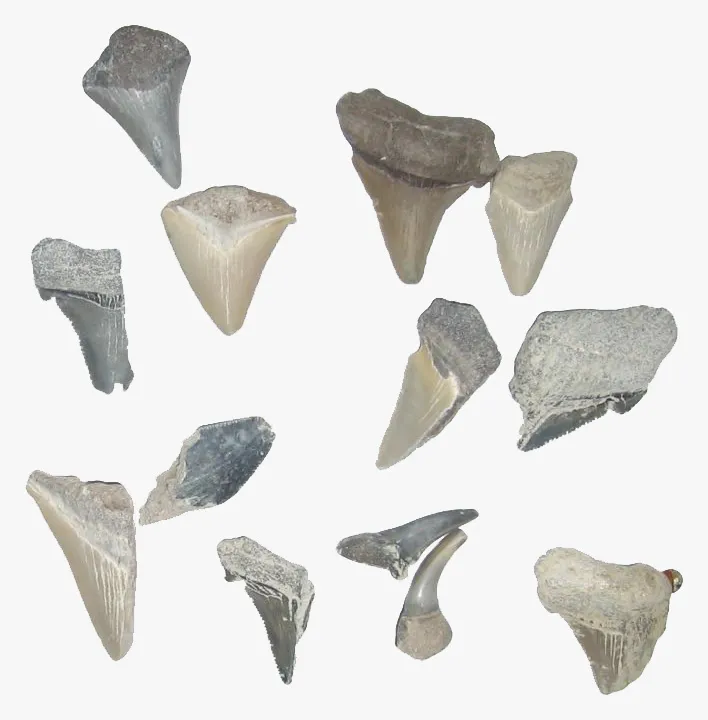
Devonian to present (419-0 million years ago)
Sharks have been patrolling the world’s oceans since the Devonian period, over 400 million years ago. Because their skeletons are made of cartilage rather than bone, shark bodies rarely fossilize — but their teeth are a different story. Composed of a hard enameloid crown over a dentine core, shark teeth are extremely durable and preserve beautifully. A single shark can produce thousands of teeth in its lifetime as old teeth are continuously shed and replaced, which makes shark teeth among the most abundant vertebrate fossils on Earth. In the southeastern United States, Miocene and Pliocene marine deposits yield shark teeth by the thousands, making them one of the best fossils for beginning collectors.
How to Identify Shark Teeth
Shark teeth vary enormously by species, but they all share a basic two-part structure: a crown (the blade that was exposed above the gum line) and a root (the base that anchored the tooth in the jaw cartilage).
Key Features to Look For
- Crown shape — This is the primary identification feature. Crowns can be triangular, narrow and pointed, broadly flat, or even multi-cusped depending on species and jaw position.
- Serrations — Many species (megalodon, great white, tiger sharks) have fine serrations along the cutting edges of the crown. Use a hand lens to examine these closely — serration pattern is diagnostic.
- Root shape — The root typically has two lobes separated by a nutrient groove. Root shape and size help determine species and whether the tooth is from the upper or lower jaw.
- Enameloid — The glossy, hard coating on the crown. In fossils, the enameloid is often dark gray, black, or brown, while the root is lighter in color.
- Lateral cusplets — Small secondary points flanking the main crown, present in some species (mako, sand tiger) and absent in others.
- Bourlette — A band of enameloid at the base of the crown, visible in some species like megalodon. Its texture and width help with identification.
Tooth Position and Heterodonty
Sharks have different tooth shapes in different parts of their jaws, a trait called heterodonty. Front teeth (anterior) are typically tall and narrow for piercing. Side teeth (lateral) are broader and more triangular for cutting. Rear teeth are smaller and sometimes very different in shape. Upper and lower jaw teeth also differ. This means a single shark species can produce teeth that look quite different depending on jaw position, which is a common source of confusion for beginners.
Color and Preservation
Fossil shark teeth come in every color depending on the minerals in the surrounding sediment: black, gray, brown, tan, blue-gray, reddish, and even green. Color indicates the chemistry of fossilization, not the species or age. Teeth from Peace River, Florida, are often black or dark brown. Teeth from Calvert Cliffs, Maryland, tend to be gray or tan.
Distinguishing Shark Teeth from Lookalikes
- Ray teeth — Rays (relatives of sharks) have flat, pavement-like crushing plates rather than pointed teeth. They look like small hexagonal tiles and lack the crown-and-root structure of shark teeth.
- Bony fish teeth — Teleost (bony fish) teeth are generally small, conical or peg-like, and lack the distinct two-part crown/root structure. They also lack enameloid’s characteristic sheen.
- Pointed rocks — Dark, triangular rock fragments are commonly mistaken for shark teeth. Check for enameloid sheen, a visible root, and the smooth-to-serrated cutting edge that genuine teeth display.
Common US Species for Collectors
Otodus megalodon (Florida, North Carolina, South Carolina, Maryland, New Jersey)
- Age: Miocene to Pliocene (~23-3.6 Ma)
- Size: Teeth range from 2 cm (juveniles) to over 17 cm; most collected specimens are 5-12 cm
- Where: Peace River and offshore sites in Florida; Aurora and Summerville phosphate deposits in the Carolinas; Calvert Cliffs, Maryland
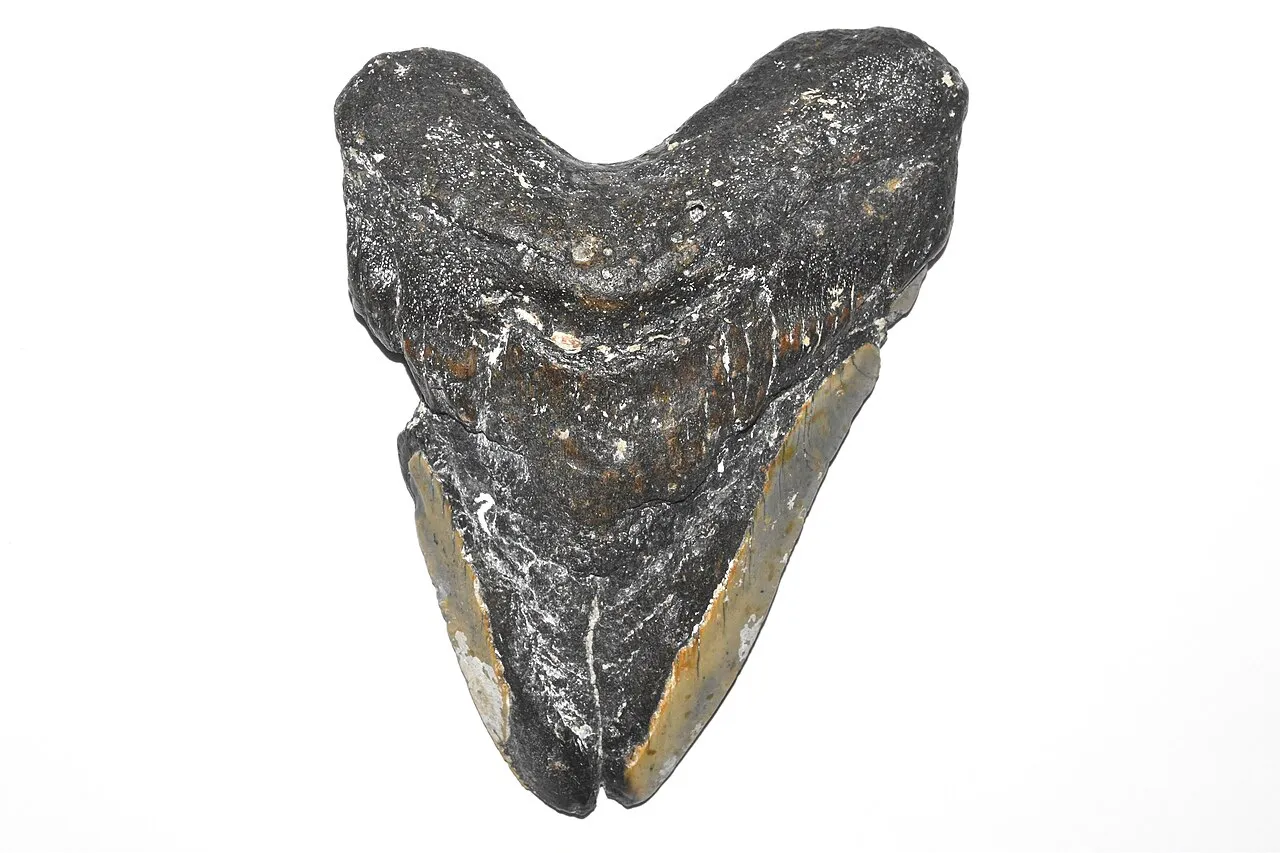
- Notes: The iconic giant shark tooth. Broad, triangular crown with fine, regular serrations and a visible bourlette. The root is thick and massive with a distinct chevron shape. Even partial or broken megalodon teeth are prized by collectors.
Isurus hastalis (cosmopolitan in US Miocene sites)
- Age: Miocene to Pliocene (~23-5 Ma)
- Size: 3-7 cm
- Where: Same formations as megalodon across the southeastern US
- Notes: The extinct broad-tooth mako. Smooth cutting edges (no serrations), broad triangular crown, and a distinctive graceful shape. Often confused with great white teeth, but the lack of serrations is diagnostic. One of the most aesthetically pleasing fossil shark teeth.
Carcharodon carcharias (great white shark) (North Carolina, Florida, California)
- Age: Pliocene to present (~5-0 Ma)
- Size: 2-5 cm
- Where: Pliocene and Pleistocene deposits; less common than Miocene species
- Notes: Triangular with serrations, broadly similar to megalodon but much smaller, thinner, and with a flatter root. Current taxonomy places great whites in a separate lineage from megalodon, descended from mako ancestors rather than megatooth sharks.
Hemipristis serra (snaggletooth shark) (Florida, Carolinas, Maryland)
- Age: Miocene (~23-5 Ma)
- Size: 1-3 cm
- Where: Extremely common at all major southeastern collecting sites
- Notes: Upper teeth are broad and serrated; lower teeth are narrow, curved, and hook-like with coarse serrations. The sharp difference between upper and lower teeth (heterodonty) confuses many beginners into thinking they are from two different species.
Squalicorax pristodontus (crow shark) (New Jersey, Kansas, Alabama)
- Age: Late Cretaceous (~100-66 Ma)
- Size: 1-3 cm
- Where: Cretaceous chalk and marl formations, especially the Navesink Formation in New Jersey and the Niobrara Chalk of Kansas
- Notes: A Cretaceous shark with distinctive, short, broad teeth with heavy serrations. The teeth superficially resemble a miniature great white tooth. Found alongside mosasaur and ammonite fossils. An excellent species for collecting teeth from the Age of Dinosaurs.
Understanding Shark Tooth Ages
The age of a fossil shark tooth is determined by the formation it comes from, not by its color or condition. The major collecting horizons in the US span a wide range:
- Cretaceous (145-66 Ma) — Squalicorax, Cretoxyrhina (the Ginsu shark), and early lamniform sharks. Found in chalk and marl formations in Kansas, New Jersey, Alabama, and Mississippi.
- Eocene (56-34 Ma) — Early modern shark lineages. Found in coastal plain deposits of the southeastern US.
- Miocene (23-5 Ma) — The golden age of shark tooth collecting. Otodus megalodon, Isurus hastalis, Hemipristis serra, and dozens of other species thrived in warm, shallow seas. The Calvert Formation (Maryland), Pungo River Formation (North Carolina), and various Florida formations produce most of the teeth collectors find.
- Pliocene to Pleistocene (5-0.01 Ma) — Modern species appear. Great white, bull, tiger, and hammerhead teeth found in younger coastal deposits.
How to Collect Shark Teeth
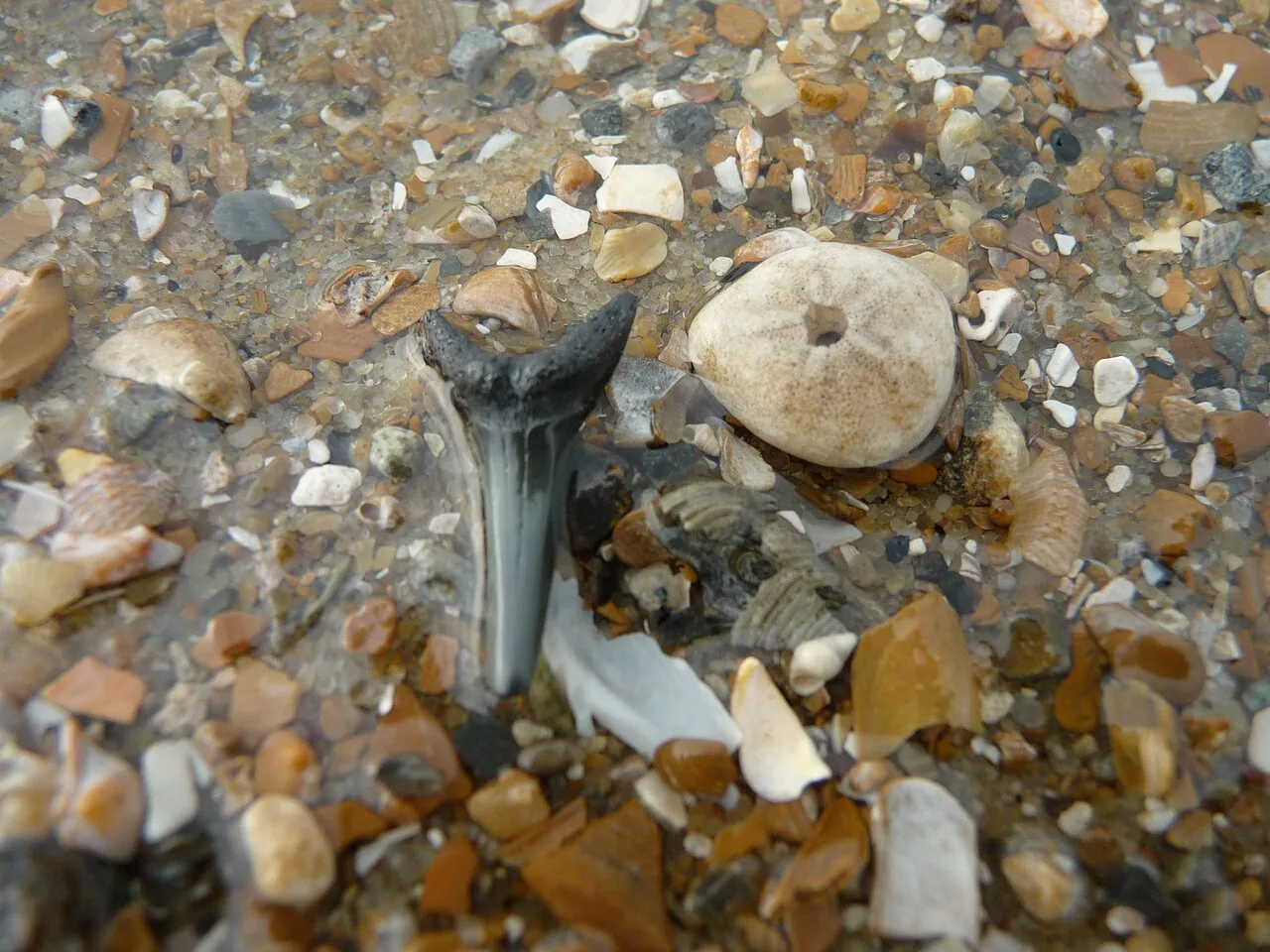
- Screen the creeks — In Florida, the Peace River and its tributaries are legendary. Wade in shallow water and use a sifting screen (a framed mesh basket) to scoop gravel from the river bottom. Sort through the residue for dark, glossy teeth.
- Walk the beach — Shark teeth wash up on beaches along the Atlantic and Gulf coasts. Venice, Florida, is called the “Shark Tooth Capital of the World.” Look in the shell line and tidal wrack after storms.
- Visit exposed cliffs and quarries — Calvert Cliffs in Maryland, the Aurora phosphate mine spoil piles in North Carolina, and Summerville, South Carolina exposures all produce large quantities of teeth.
- Look for the shine — Enameloid has a characteristic glassy luster that stands out among shell fragments and gravel. Train your eye to spot this sheen.
- Keep the small teeth — Beginners often only look for large teeth, but small teeth (under 1 cm) are far more common and many represent interesting species. Bring a hand lens.
- Check local regulations — Collecting on public beaches is generally allowed, but some sites (state parks, federal lands, certain quarries) have restrictions. Always verify before collecting.
- Bring the right gear — A mesh sifting screen (1/4 inch hardware cloth in a wooden frame), a small garden trowel, a bucket, and zip-lock bags for organizing finds. A spray bottle helps rinse teeth for quick field identification.
- Document your finds — Record the location, formation, and general matrix type for every tooth. Teeth without locality data are far less valuable scientifically and even to serious collectors.
Preservation and Display
- Rinse teeth in fresh water to remove sand and sediment. A soft toothbrush works well.
- Do not use acid on shark teeth — it will damage the enameloid and dissolve the root.
- Fragile roots can be stabilized with a thin application of Paraloid B-72 dissolved in acetone.
- For display, sort teeth by species or by size. Small acrylic stands, gem jars, or Riker cases work well.
- Large megalodon teeth display beautifully on small custom stands or clear acrylic easels.
- Label with species identification, locality, formation, and approximate age. Photograph your best finds with a scale bar.
- For serious collectors, consider building a jaw reconstruction display by arranging teeth from different jaw positions (anterior, lateral, posterior) in anatomical order. Reference jaw sets of modern shark relatives to guide placement.
- Store small teeth in individual gem jars or compartmented boxes to prevent them from rattling together and chipping.
- Keep a reference collection of common species from your favorite locality. Over time, you will develop an eye for subtle differences that make field identification faster and more accurate.
Reference Photos
Commonly Confused With
- Ray teeth (flat, pavement-like crushing plates)
- Bony fish teeth (smaller, often conical, lack distinct root)
- Pointed rocks or shell fragments