Ammonites Identification Guide
Devonian to Cretaceous (419-66 million years ago)
Ammonites were free-swimming marine cephalopods — relatives of modern squids, octopuses, and the chambered nautilus. They first appeared in the Devonian period and diversified into thousands of species before vanishing in the same mass extinction that killed the non-avian dinosaurs 66 million years ago. Their shells, divided into gas-filled chambers that controlled buoyancy, are common fossils in marine rocks worldwide. In the United States, ammonites are especially abundant in the Cretaceous formations of the Western Interior Seaway, which once split North America in half.
Like their living relative the nautilus, ammonites controlled their buoyancy by pumping fluid in and out of their shell chambers through the siphuncle. This allowed them to regulate their depth in the water column. Most ammonites were likely active predators or scavengers, propelling themselves by jet propulsion — squirting water through a muscular funnel called the hyponome. They occupied ecological niches similar to modern fish, and their rapid evolution and widespread distribution make them invaluable index fossils for dating marine rocks.
How to Identify Ammonites
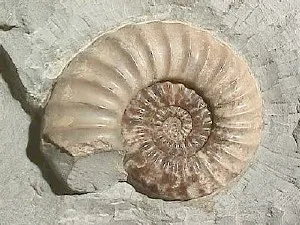
The classic ammonite is a flat-coiled (planispiral) shell, meaning it coils in a single plane like a ram’s horn. However, some species evolved straight shells, helical coils, or irregular shapes collectively known as heteromorph ammonites.
Key Features to Look For
- Coiled shell — Most ammonites are symmetrically coiled in a flat spiral. The shell gets wider with each successive whorl.
- Suture patterns — Where internal walls (septa) meet the outer shell, they create lines called sutures. In early ammonites these are simple curves; in later species they become wildly complex, fractal-like patterns. Sutures are the single most reliable way to distinguish ammonites from nautiloids.
- Siphuncle — A thin tube running through all the chambers, used to regulate gas and liquid for buoyancy. In ammonites, the siphuncle runs along the outer edge (ventral) of the shell. In nautiloids, it runs through the center.
- Ribbing and ornamentation — Many species have pronounced ribs, knobs (tubercles), or keels running along the shell exterior.
- Chamber structure — If broken open, you can see the individual chambers (camerae) separated by curved walls (septa).
Ammonite vs. Nautilus
This is the most common misidentification. Key differences:
- Sutures — Ammonites have complex, wavy to fractal suture lines. Nautilus sutures are simple, gently curved lines.
- Siphuncle position — Ammonite siphuncle is at the outer edge; nautilus siphuncle runs through the center of each chamber.
- Shell texture — Ammonites usually show ribs, spines, or ornamentation. Nautilus shells are generally smooth.
Ammonite vs. Gastropod (Snail)
Gastropod shells coil in three dimensions (a helical spire), so when viewed from the side, you see a pointed cone shape. Ammonite shells coil in one plane, so they look like a flat disk or wheel from the side. Gastropods also lack internal chambers and suture lines.
Suture Pattern Types
Ammonite suture patterns evolved increasing complexity over geologic time, and recognizing the general type helps narrow down the age of your specimen:
- Goniatitic sutures — Simple, rounded lobes and saddles. Found in Devonian and Carboniferous ammonites (goniatites). The pattern looks like a series of gentle waves.
- Ceratitic sutures — Rounded saddles but serrated (saw-toothed) lobes. Characteristic of Triassic ammonites (ceratites).
- Ammonitic sutures — Both lobes and saddles are highly subdivided into intricate, fractal-like branching patterns. Found in Jurassic and Cretaceous ammonites. These are the most complex and visually striking.
Heteromorph Ammonites
Not all ammonites followed the classic flat-spiral form. Heteromorphs evolved unusual shell shapes, especially in the Cretaceous:
- Baculites — Straight, stick-like shells (only the juvenile stage is coiled)
- Turrilites — Helically coiled like a tall snail shell
- Nipponites — Irregularly tangled coils, among the most bizarre fossil shapes
- Scaphites — Partially uncoiled, with a hook-shaped living chamber
These unusual forms are all confirmed as ammonites by their complex suture patterns and ventral siphuncle.
Common US Species for Collectors
Dactylioceras commune (Texas)
- Age: Early Jurassic (~180 Ma)
- Size: 3-8 cm diameter
- Where: Jurassic exposures in central Texas
- Notes: Small, ribbed ammonites often preserved in ironstone nodules. The strong, evenly-spaced ribbing makes them easy to identify. A good beginner ammonite.
Placenticeras meeki (South Dakota, Montana, Kansas)
- Age: Late Cretaceous (~80 Ma)
- Size: 10-40 cm diameter; some exceed 60 cm
- Where: Pierre Shale exposures in South Dakota and Montana; Niobrara and Pierre formations in Kansas
- Notes: One of the classic Western Interior Seaway ammonites. Large, relatively flat shells with subtle ribbing. Specimens from South Dakota are occasionally found with original iridescent shell material (ammolite).
Baculites compressus (South Dakota, Montana, Kansas)
- Age: Late Cretaceous (~75-69 Ma)
- Size: Fragments typically 5-20 cm; complete animals reached over 1.5 meters
- Where: Pierre Shale, Fox Hills Formation across the Great Plains
- Notes: A straight (uncoiled) ammonite — only the juvenile shell is coiled. Extremely common as fragments in Cretaceous shales. Look for the characteristic complex suture lines on the surface to confirm identification.
Hoplites dentatus (New Jersey, Texas)
- Age: Early-Middle Cretaceous (~112 Ma)
- Size: 4-10 cm diameter
- Where: Cretaceous marl and clay deposits of New Jersey coastal plain; central Texas
- Notes: A strongly ribbed ammonite with distinctive bifurcating (forking) ribs. The genus is an important index fossil for the Albian stage of the Cretaceous.
Where Ammonites Lived
Ammonites inhabited every ocean on Earth, from shallow coastal waters to the open sea. The Western Interior Seaway — a shallow sea that covered the Great Plains during the Late Cretaceous — was home to enormous populations of ammonites including Baculites, Placenticeras, and Scaphites. When this seaway retreated as the Rocky Mountains rose, it left behind thousands of feet of marine shale packed with ammonite fossils from Montana to Texas.
In the eastern US, Cretaceous and Jurassic marine deposits along the Atlantic Coastal Plain (New Jersey, Delaware, the Carolinas) also yield ammonites, though they are less abundant than in the Western Interior. Devonian and Carboniferous goniatites (early ammonites) can be found in the Appalachian region but are much less common in casual collecting.
How to Collect Ammonites
- Target Cretaceous marine formations — In the US, the richest collecting comes from rocks deposited in the Western Interior Seaway. The Pierre Shale, Niobrara Formation, and Fox Hills Formation stretch from Montana through the Dakotas and Kansas.
- Check weathered exposures — Ammonites often weather out of soft shale and clay. Walk along eroded hillsides, creek banks, and badlands exposures to find specimens on the surface.
- Look for concretions — Many of the best-preserved ammonites are found inside rounded concretions (hard nodules) within softer shale. Crack them carefully with a rock hammer.
- Collect Baculites fragments — Straight ammonite fragments are extremely common in Cretaceous shale. They make excellent starter fossils and clearly show suture patterns.
- Note the orientation — Record which direction the aperture (opening) faces and photograph the specimen in situ before removal.
- Wrap carefully — Ammonites preserved in shale can be fragile. Wrap in tissue and newspaper before placing in your pack.
Preservation and Display
- Clean with gentle brushing and water. Avoid soaking shale-hosted specimens, as the rock may disintegrate.
- For specimens in concretions, use a pin vise or pneumatic air scribe to carefully remove matrix from the shell.
- Ammonites with iridescent shell (ammolite) should not be cleaned with chemicals — water and a soft brush only.
- Apply a thin coat of Paraloid B-72 to stabilize fragile specimens or to bring out suture patterns.
- Display flat on a stand or in a Riker case. Label with species, formation, locality, and age.
- Large Placenticeras specimens make dramatic display pieces on small easel stands.
- Baculites fragments can be displayed in rows sorted by size, or mounted in clear-topped gem boxes to show the suture patterns.
- For cut-and-polished ammonites (often sold commercially), the internal chamber structure is revealed — these make excellent educational display pieces showing the septa, siphuncle, and chambers.
- Store fragile shale specimens individually in padded boxes. Avoid stacking heavy specimens on top of lighter ones.
Commonly Confused With
- Nautilus shells (simpler sutures, siphuncle position differs)
- Gastropods/snails (coiled in a spire, not a flat plane)