Brachiopods Identification Guide
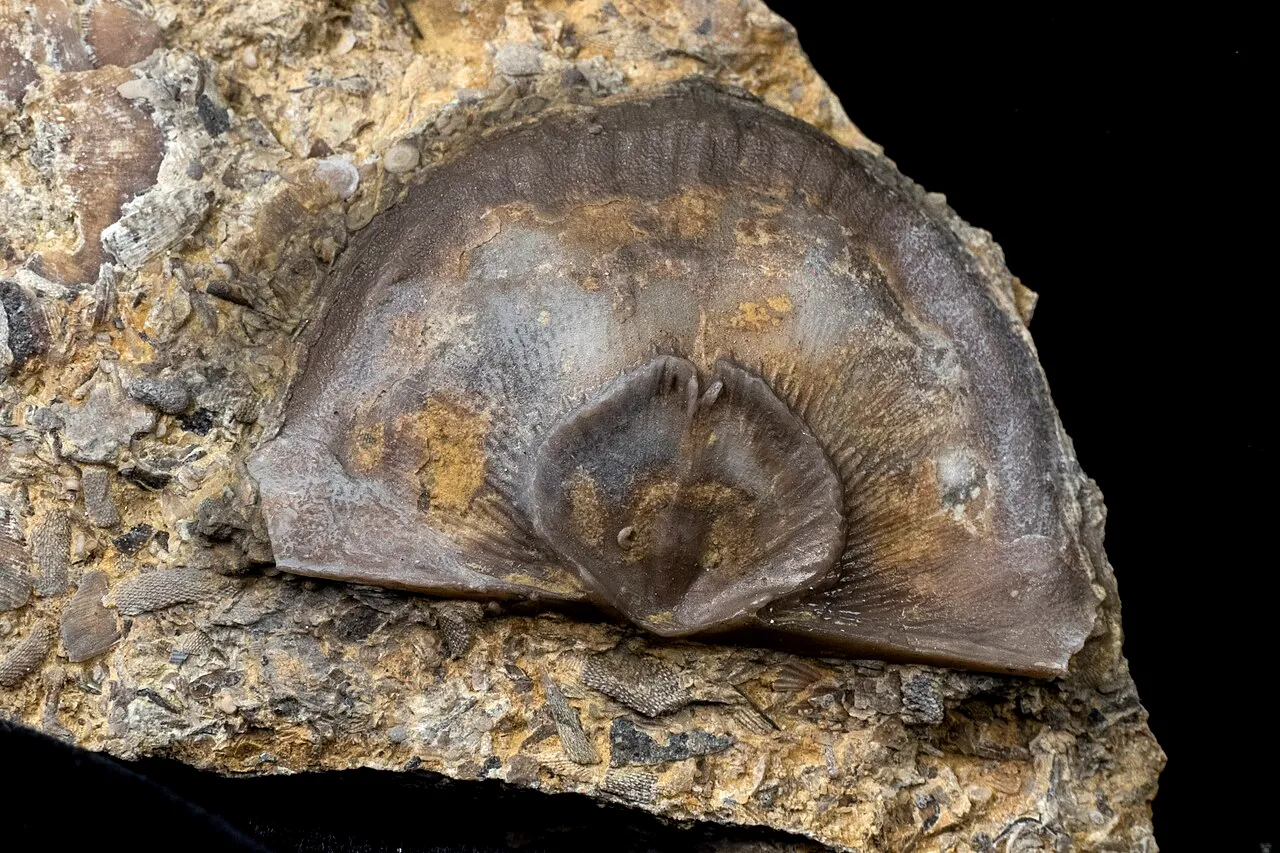
Cambrian to present (521-0 million years ago, mostly Paleozoic)
Brachiopods are marine invertebrates that have been living on the ocean floor since the early Cambrian period, over 500 million years ago. Though they look like clams at first glance, brachiopods are not mollusks at all — they belong to their own phylum, Brachiopoda. During the Paleozoic era, brachiopods were among the most abundant and diverse shelled animals in the sea. Today only about 400 species survive, mostly in deep or cold water, but their fossils are extraordinarily common in Ordovician through Permian rocks across the American Midwest and Appalachian region.
Understanding the difference between brachiopods and bivalves is one of the most useful skills a fossil collector can develop, because brachiopods are extraordinarily abundant in Paleozoic rocks and are frequently misidentified as clams. The two groups are not even closely related: bivalves are mollusks (phylum Mollusca), while brachiopods have their own entire phylum. Internally, brachiopods fed using a coiled, tentacle-bearing organ called the lophophore, which filtered microscopic food particles from seawater — a feeding strategy completely unlike the gills and siphons of clams.
How to Identify Brachiopods
The most important concept for identifying brachiopods is understanding their symmetry — and how it differs from the symmetry of bivalves (clams and mussels).
The Symmetry Test
- Brachiopods — Each individual valve is bilaterally symmetrical. If you draw a line from the hinge to the front margin down the middle of one valve, the left half mirrors the right half. However, the two valves are different sizes: one (the pedicle valve) is larger and more convex, and the other (the brachial valve) is smaller or flatter.
- Bivalves (clams) — Each valve is asymmetrical on its own, but the two valves are mirror images of each other. The plane of symmetry runs between the two valves, not across them.
This single test will correctly sort brachiopods from bivalves the vast majority of the time.
Other Key Features
- Pedicle opening — Many brachiopods have a hole (foramen) or notch at the beak of the larger valve. This is where the pedicle (a fleshy stalk) emerged to anchor the animal to the sea floor. Clams never have this feature.
- Ribbing (costae) — Many brachiopods have fine ribs radiating from the beak to the margin. While some clams are also ribbed, brachiopod ribs are symmetrically arranged on each valve.
- Fold and sulcus — Many species have a pronounced fold (raised ridge) on one valve and a matching sulcus (groove) on the other, creating a zigzag commissure (where the valves meet).
- Hinge structure — Brachiopod hinges differ fundamentally from bivalve hinges. Articulate brachiopods have simple tooth-and-socket hinges along a straight hinge line.
Major Brachiopod Groups
Knowing the broad groups helps narrow identification:
- Strophomenids — Wide hinge line, one valve convex and one concave (like Rafinesquina). Very common in Ordovician and Silurian rocks.
- Orthids — Biconvex (both valves bulging outward), strong ribbing, wide hinge line. Common in Ordovician rocks.
- Spiriferids — Often have a wide, wing-like hinge line, strong fold and sulcus, and internal spiral supports (spiralia) for the lophophore. Common in Devonian rocks.
- Rhynchonellids — Small, strongly ribbed, with a prominent zigzag commissure. Range from Ordovician to present.
- Terebratulids — Smooth or lightly ribbed, rounded shape, prominent pedicle foramen. The most common living brachiopods today.
- Productids — Large, often spiny brachiopods with a deeply convex pedicle valve and a flat or concave brachial valve. Characteristic of Carboniferous and Permian rocks. Some species cemented directly to the sea floor rather than using a pedicle.
Quick Field Identification Checklist
When you pick up a two-valved shell fossil, run through these checks:
- Hold the shell with the hinge at the top. Look at one valve face-on. Is the left half a mirror image of the right half? If yes, it is likely a brachiopod.
- Look at the hinge area. Is there a hole or notch (pedicle foramen)? If yes, it is almost certainly a brachiopod.
- Compare the two valves. Are they noticeably different sizes or shapes (one more convex, one flatter)? This suggests brachiopod.
- If the two valves are mirror images of each other and each individual valve is asymmetrical, it is probably a bivalve (clam).
Common US Species for Collectors
Rafinesquina alternata (Ohio, Indiana, Kentucky)
- Age: Upper Ordovician (~450 Ma)
- Size: 3-6 cm wide
- Where: Cincinnatian Series limestones and shales in the Cincinnati Arch region — road cuts, creek beds, and quarries in southwestern Ohio, southeastern Indiana, and northern Kentucky
- Notes: An extremely common strophomenid brachiopod. One valve is convex, the other concave, giving it a distinctive “taco shell” profile. Fine alternating ribs (costae and costellae) cover the surface. Often found in dense clusters on bedding planes.
Platystrophia ponderosa (Ohio, Indiana, Kentucky)
- Age: Upper Ordovician (~450 Ma)
- Size: 2-4 cm wide
- Where: Same Cincinnatian formations as Rafinesquina
- Notes: A robust, strongly biconvex brachiopod with a prominent fold and sulcus. The strong ribbing and wide hinge line make it easy to recognize. One of the most collected Ordovician brachiopods in North America.
Mucrospirifer mucronatus (New York, Ohio, Indiana)
- Age: Middle Devonian (~385 Ma)
- Size: 3-5 cm wide, but the hinge line can extend to 8 cm with pointed “wings”
- Where: Devonian shales and limestones of the Appalachian Basin — Hamilton Group in New York, equivalent formations in Ohio
- Notes: Immediately recognizable by its extremely wide, wing-like hinge extensions (mucronate hinge). A spiriferid brachiopod with a deep sulcus and strong fold. The internal spiral supports (spiralia) for the feeding organ are occasionally preserved.
Composita subtilita (Texas, Oklahoma, Kansas, Missouri)
- Age: Pennsylvanian to Permian (~315-260 Ma)
- Size: 1-3 cm
- Where: Pennsylvanian and Permian limestones throughout the midcontinent — road cuts and quarries in north-central Texas, eastern Oklahoma
- Notes: A smooth, rounded brachiopod lacking strong ribbing, which can make it tricky for beginners. Look for the characteristic fold and sulcus, the pedicle foramen, and the bilateral symmetry of each valve. Very common in late Paleozoic marine rocks.
Where to Find Brachiopods in the US
The absolute best place to collect brachiopods in the United States is the Cincinnati Arch region, where the Ohio, Indiana, and Kentucky borders converge. Upper Ordovician limestones and shales here are packed with beautifully preserved brachiopods, along with bryozoans, crinoids, and corals. Caesar Creek State Park and Stonelick State Park in Ohio are well-known collecting localities.
For Devonian brachiopods, the Hamilton Group exposures across central New York state are world-class. Road cuts along the New York State Thruway and creek beds near Cazenovia and Hamilton produce excellent spiriferid and rhynchonellid brachiopods.
Pennsylvanian and Permian brachiopods are common in the limestones of north-central Texas (the Mineral Wells and Graham areas), eastern Oklahoma, and southeastern Kansas. These younger brachiopods include productids, which have distinctive spine bases on the pedicle valve and sometimes reached large sizes.
How to Collect Brachiopods
- Target Ordovician and Devonian limestones — The richest brachiopod collecting in the US is in the Cincinnati Arch area (Ohio/Indiana/Kentucky border) for Ordovician species, and in New York and the Appalachian region for Devonian species.
- Split shale and thin limestone — Brachiopods often sit on bedding planes. Use a thin chisel to split rock along natural layers.
- Check weathered surfaces — Brachiopods weather out of limestone and shale readily. Surface scanning along creek beds and road cuts after rain can be very productive.
- Collect both valves — Brachiopods often separate into individual valves during fossilization. Try to find specimens with both valves still articulated (joined together), as these are more valuable for identification.
- Look for shell beds — Brachiopods were gregarious animals and are frequently preserved in dense accumulations. If you find one, there are usually many more.
- Practice the symmetry test — Bring a hand lens and practice distinguishing brachiopods from bivalves in the field. It becomes second nature quickly.
Preservation and Display
- Most brachiopods in limestone are quite durable and can be cleaned with water and a stiff brush.
- Shale-hosted specimens are more delicate — use a soft brush and avoid prolonged soaking.
- A dilute acetic acid bath (5% white vinegar) can be used to carefully etch away limestone matrix around a brachiopod, but monitor closely as the shell itself is also calcium carbonate and will dissolve if over-treated.
- Display in Riker cases, specimen trays, or small boxes with cotton lining.
- Group specimens to show the range of variation within a species, or to compare brachiopods with bivalves to illustrate the symmetry differences.
- Label with species, formation, locality, and geological age.
- Consider creating a comparative display with brachiopods and bivalves side by side, labeled to highlight the symmetry differences. This makes an excellent educational exhibit for classrooms and fossil shows.
- Internal molds (steinkerns) are common and can show impressions of internal structures like muscle scars, dental plates, and even the spiral lophophore supports (spiralia) in spiriferid brachiopods. These are scientifically valuable and worth keeping even if they look plain externally.
Commonly Confused With
- Bivalves/clams (symmetry between valves, not across them)
- Concretions (rounded specimens can resemble smooth stones)