Petrified Wood Identification Guide
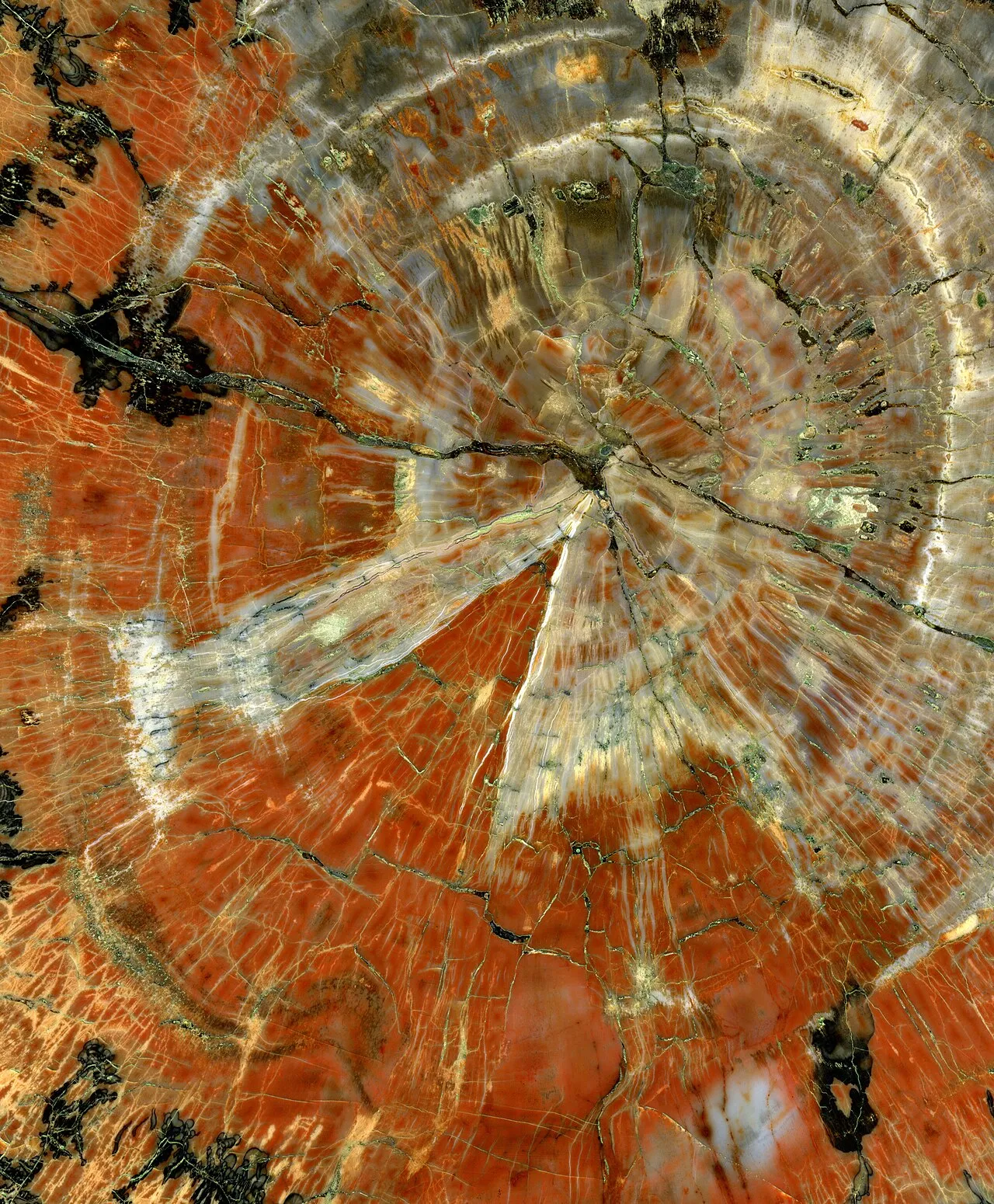
Various periods (most collected specimens are Triassic to Miocene, 252-5 million years ago)
Petrified wood forms when a tree is buried in sediment — often volcanic ash — and groundwater rich in dissolved minerals slowly percolates through the wood. Over thousands to millions of years, the original organic cell walls are replaced molecule by molecule with silica (silicon dioxide), calcite, pyrite, or other minerals. The result is a piece of stone that preserves the external shape, internal grain, growth rings, and even individual cell structure of the original tree. The most common replacing mineral is silica in the form of microcrystalline quartz (chalcedony), which produces the hard, colorful, and often gem-quality specimens that collectors prize.
How to Identify Petrified Wood
Petrified wood is one of the easier fossils to identify because it literally looks like wood turned to stone. However, confirming that a specimen is genuinely petrified wood (and not just a patterned rock) requires checking a few key features.
Key Features to Look For
- Wood grain — The most obvious feature. Look for the parallel lines of wood grain running along the length of the specimen, just as you would see on a piece of modern lumber.
- Growth rings — On cross-sections (pieces cut or broken perpendicular to the trunk), you should see concentric growth rings, just like a tree stump.
- Bark — The exterior of some specimens preserves the rough texture of bark, sometimes in a different color than the interior wood.
- Cellular structure — Under a hand lens or low-power microscope, well-preserved petrified wood reveals individual plant cells. This is the definitive test. Agate and jasper lack cellular structure.
- Weight — Petrified wood is much heavier than a similarly sized piece of modern wood. It has the density of quartz (about 2.65 g/cm3) because it is quartz.
- Hardness — Silicified wood is hard enough to scratch glass (Mohs hardness 7). This distinguishes it from calcite-replaced wood (Mohs 3) and from modern wood.
- Fracture — Broken surfaces show a mix of conchoidal (glassy, curved) fracture through the silica and irregular fracture along original wood structures.
Color
The base color of silicified wood is white or gray (pure quartz), but trace elements and minerals create a spectacular palette:
- Red, orange, pink — Iron oxides (hematite)
- Yellow, brown — Iron oxides and hydroxides (limonite, goethite)
- Purple, violet — Manganese dioxide
- Black — Carbon, manganese, or iron sulfides (pyrite)
- Green — Reduced iron compounds or chromium
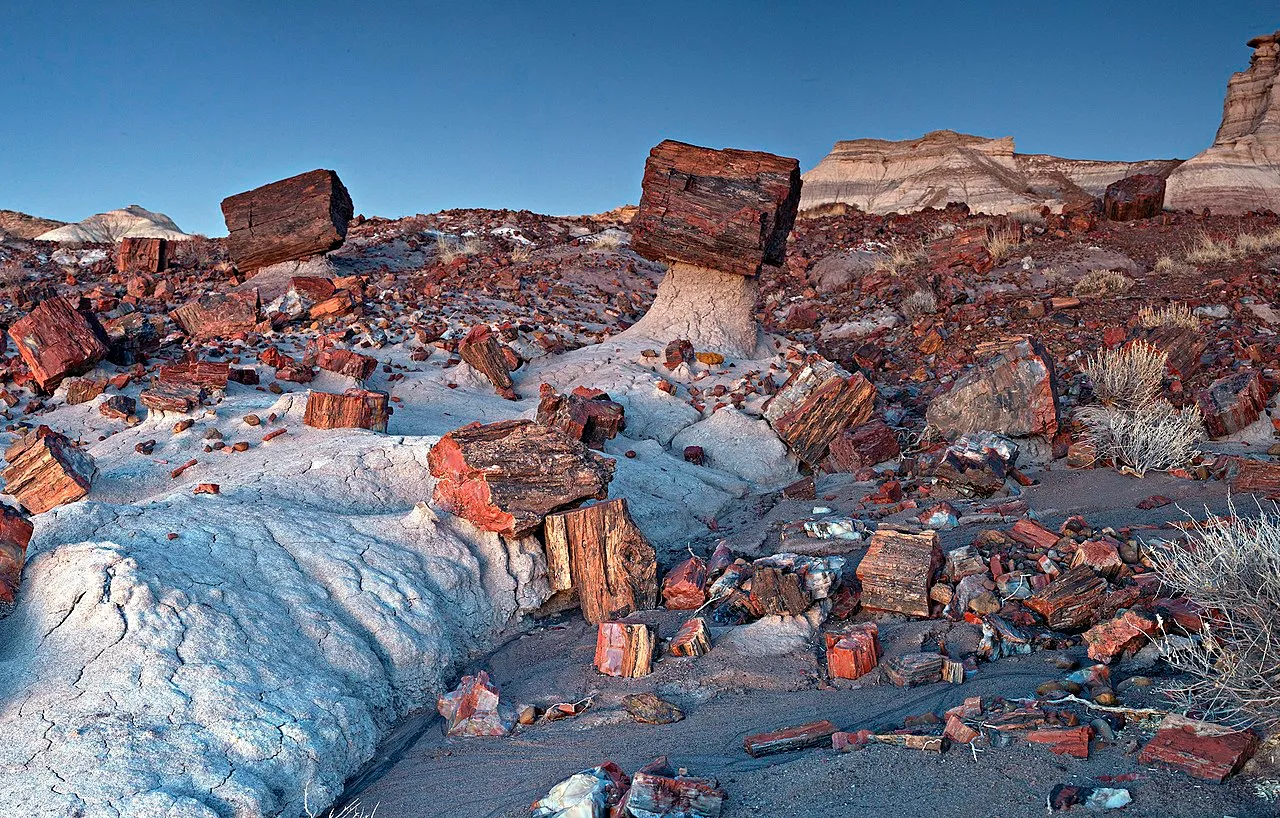
The most colorful specimens come from Arizona’s Chinle Formation, where volcanic ash provided abundant silica and trace minerals.
Types of Mineral Replacement
Not all petrified wood is silicified. The replacing mineral affects the appearance, hardness, and collectibility:
- Silicification (quartz/chalcedony) — By far the most common. Hard (Mohs 7), durable, often colorful, and can take a brilliant polish. This is the petrified wood most people picture.
- Calcite replacement — Softer (Mohs 3), usually white to tan, reacts with acid. Less common and less durable than silicified wood.
- Pyritization — Wood replaced by iron sulfide (pyrite). Metallic golden color. Rare and striking but vulnerable to pyrite decay if not stored properly.
- Opalization — Wood replaced by opal (hydrated silica). Can show play of color (precious opal) in exceptional specimens, particularly from Australia, though rare opalescent pieces occur in the western US.
Identifying Wood Type
With a hand lens or microscope, you can often identify the type of tree that became petrified:
- Conifers — Orderly rows of tracheids (water-conducting cells) with bordered pits visible on radial sections. Most Triassic petrified wood from Arizona is coniferous.
- Hardwoods (angiosperms) — Visible pores (vessel elements) in cross-section, giving a dotted or ring-porous appearance. Found in younger (Cenozoic) petrified wood.
- Palm wood — Distinctive scattered dots in cross-section, which are the vascular bundles characteristic of monocots. Common in Gulf Coast Oligocene-Miocene deposits.
Common Types for Collectors
Araucarioxylon arizonicum (Arizona)
- Age: Late Triassic (~225 Ma)
- Size: Logs up to 60 meters long; collected pieces range from chips to large rounds
- Where: Petrified Forest National Park (viewing only — collecting is prohibited) and surrounding BLM and private lands in northeastern Arizona
- Notes: The classic petrified wood of the American Southwest. These were large conifer trees related to modern monkey puzzle trees (Araucaria). Specimens are renowned for vivid reds, yellows, and purples. Commercially available pieces come from legally collected private and BLM land outside the National Park.
Ginkgo and associated species (Washington)
- Age: Miocene (~15 Ma)
- Size: Small branches to large logs
- Where: Ginkgo Petrified Forest State Park near Vantage, Washington, and surrounding areas in central Washington
- Notes: The Ginkgo Petrified Forest preserves over 50 species of trees, making it one of the most diverse petrified wood localities in the world. Species include ginkgo, walnut, elm, maple, and various conifers. The park itself is protected, but collecting is allowed on some adjacent public lands.
Coastal Plain Petrified Wood (Mississippi, Texas, Louisiana)
- Age: Oligocene to Miocene (~34-5 Ma)
- Size: Typically small pieces and limb casts, occasionally large stumps
- Where: Gravel pits and stream beds across the Gulf Coastal Plain, particularly in central Mississippi and eastern Texas
- Notes: Mississippi designated petrified wood as its state stone. These specimens are often palm wood (Palmoxylon), identifiable by the distinctive dot pattern of vascular bundles visible in cross-section. Palm wood from the Gulf Coast polishes beautifully and is popular in lapidary work.
The Petrification Process
Understanding how wood becomes stone helps collectors appreciate what they are looking at. The process occurs in several stages:
- Burial — A tree falls and is rapidly buried by sediment, often volcanic ash, river silt, or mudflow. Rapid burial is essential to prevent decay.
- Groundwater percolation — Mineral-rich groundwater seeps through the sediment and into the wood’s cellular structure.
- Cell-by-cell replacement — Dissolved silica (or other minerals) precipitates inside and around the wood cells. The original organic material gradually breaks down and is replaced by mineral matter, preserving the cellular architecture in stone.
- Crystallization — Over millions of years, the silica crystallizes into microcrystalline quartz (chalcedony) or, in some cases, larger quartz crystals that fill cavities within the wood.
The entire process can take anywhere from thousands to millions of years, depending on groundwater chemistry, temperature, and the type of wood.
How to Collect Petrified Wood
- Know the regulations — On Bureau of Land Management (BLM) land, casual collecting of petrified wood is permitted under the Paleontological Resources Preservation Act: up to 25 pounds per day plus one piece, with a maximum of 250 pounds per year, for personal use only. Collecting is prohibited in National Parks, National Monuments, and most state parks.
- Check road cuts and gravel bars — Petrified wood often weathers out of soft sedimentary formations. Look in stream gravels, road cuts, and eroded hillsides.
- Look for the weight — Experienced collectors develop a feel for petrified wood. Pick up pieces that feel heavier than expected for their size.
- Wet the surface — Carry a spray bottle. Wetting a specimen dramatically enhances the color and grain pattern, helping you evaluate quality in the field.
- Look for quality indicators — The most collectible pieces show clear growth rings, vivid color, intact bark, or evidence of original wood features like knots and branch scars.
- Consider cutting and polishing potential — Rounded pieces and cross-sections often reveal their best features only when cut and polished. Evaluate the exterior grain to estimate what the interior might look like.
- Document the site — Record GPS coordinates, the geological formation, and the context (was it in place in bedrock, or loose in a gravel bed?). This information adds scientific and collecting value.
- Look for special features — Pieces showing bark, branch scars, insect borings, or fungal damage are more scientifically interesting than plain trunk wood. Specimens with multiple colors or agate-filled cavities are prized by lapidary collectors.
Preservation and Display
- Petrified wood is extremely durable (it is stone, after all) and requires little preservation work.
- Clean with water and a stiff brush. Stubborn clay or calcium carbonate coatings can be removed with a dilute acid soak (muriatic acid or white vinegar), but rinse thoroughly afterward.
- Cut surfaces can be polished to a high gloss using progressively finer grits on a lapidary wheel or flat lap (220, 400, 600, 1200, then polish with cerium oxide). Polished cross-sections showing growth rings and cell structure are stunning display pieces.
- Small specimens display well on shelves or in cabinets with good lighting to show off the colors.
- Large rounds and log sections make dramatic coffee table or shelf displays. Bookends cut from petrified wood are a classic collector item.
- Label with locality, geological formation and age, and wood type if identifiable.
- Some collectors specialize in thin-section preparation: slicing a thin wafer of petrified wood, mounting it on a glass slide, and grinding it thin enough to be translucent. Under a microscope, the individual cell structure becomes beautifully visible. This is the gold standard for wood identification and makes for a fascinating hobby within the hobby.
- Petrified wood is also popular in lapidary arts beyond simple polishing. Cabochons cut from colorful specimens are used in jewelry, and small polished slabs are sometimes set into belt buckles, bolo ties, and pendants.
- For outdoor display, petrified wood is durable enough to withstand weather. Large pieces are often used as garden features or yard art in the American Southwest.
Reference Photos
Commonly Confused With
- Agate or jasper (lacks wood grain and cellular structure)
- Patterned rocks with parallel lines (lack cellular detail)
- Ironstone concretions (similar color but no wood texture)