Crinoids Identification Guide
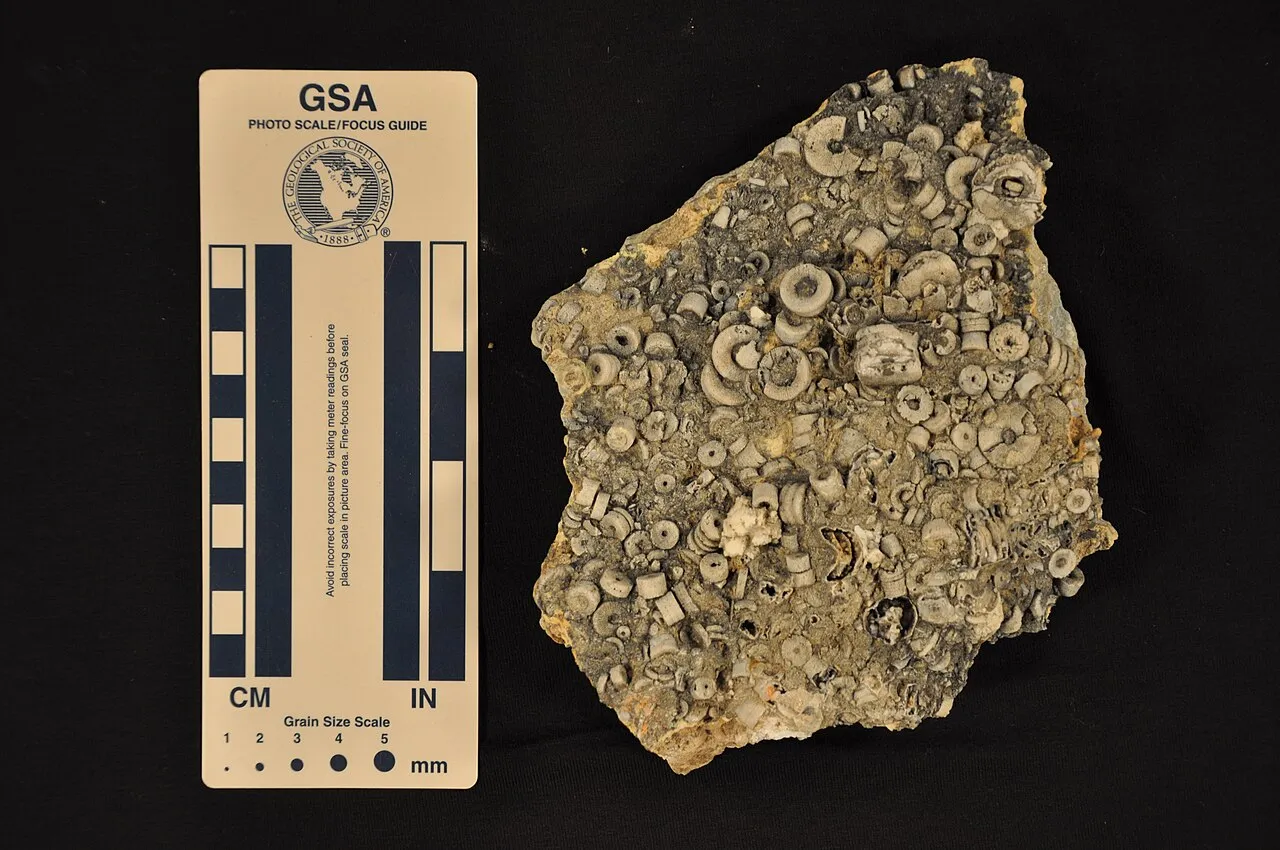
Ordovician to present (485-0 million years ago)
Crinoids are among the most beautiful and fascinating fossils a collector can find. These marine animals belong to the phylum Echinodermata, making them relatives of starfish, sea urchins, and sand dollars — not plants, despite their flower-like appearance and the common name “sea lilies.” A complete crinoid consisted of a root-like holdfast anchored to the sea floor, a long stem (column) made of stacked disc-shaped segments, and a cup-shaped head (calyx) with feathery arms that filtered food particles from the water. During the Paleozoic era, crinoids were so abundant that their broken skeletal remains formed thick beds of limestone. Individual crinoid stem segments, called columnals, are among the most common fossils a collector will encounter in the midwestern United States.
How to Identify Crinoids
Most crinoid fossils are fragments rather than complete animals. Knowing what each part looks like is essential for identification.
Stem Segments (Columnals)
The most frequently found crinoid fossils are individual columnals — small, round, disc-shaped segments that look like tiny wheels, buttons, or beads. Key features:
- Shape — Circular, pentagonal, or star-shaped in outline
- Central hole — A round or five-pointed opening in the center (the lumen) where the central nerve and ligaments ran
- Flat or concave faces — The top and bottom surfaces may be flat, gently concave, or show a radiating pattern of ridges (crenulae) that interlocked adjacent segments
- Size — Most columnals are 3-15 mm in diameter, though some species produced segments over 2 cm wide
- Stacked columns — Occasionally you find multiple segments still connected in a short section of stem, looking like a stack of coins or a segmented rod
Calyx (Head)
Complete calyxes are much rarer and more prized. They consist of interlocking calcite plates arranged in a cup shape, typically with five-fold symmetry. The calyx housed the animal’s vital organs and supported the feeding arms.
Arms
Crinoid arms branch repeatedly and bear small side branches (pinnules) that gave them a feathery appearance. Fossilized arms are delicate and usually preserved only in fine-grained sediments like shale or lithographic limestone.
Holdfast (Root)
The holdfast anchored the crinoid to the sea floor. It can look like a tangled mass of root-like structures or a simple disc. Holdfasts are occasionally found attached to brachiopod shells, corals, or other hard substrates, which is helpful evidence that the fossil is a crinoid and not a plant.
Why They Are Not Plants
The five-fold symmetry, calcite skeleton, and tube feet visible in well-preserved specimens all confirm crinoids as echinoderms. Their stem segments show a crystalline calcite structure (single-crystal extinction under polarized light) that is completely unlike plant tissue.
Despite their resemblance to flowers on stalks, crinoids were active filter-feeding animals. Their arms captured tiny food particles (plankton, detritus) from the water column using mucus-covered tube feet. Some crinoids could even detach from their stems and crawl or swim to new locations. Modern stalked crinoids survive primarily in deep water, but their unstalked relatives — the feather stars (comatulids) — are common on tropical reefs today.
Crinoid Limestone
In many parts of the Midwest, entire limestone formations are composed almost entirely of crinoid fragments. This rock type, called encrinite or crinoidal limestone, can be recognized by the abundant circular stem cross-sections visible on any broken or weathered surface. Burlington, Iowa, gives its name to the Burlington Limestone, one of the most famous crinoidal formations in the world.
Common US Species for Collectors
Eucalyptocrinites crassus (Indiana, Ohio, Kentucky, Tennessee)
- Age: Middle Silurian (~430 Ma)
- Size: Calyx 2-5 cm; stems up to 30 cm or more
- Where: Silurian reef limestones and dolostones, particularly in southeastern Indiana and western Ohio
- Notes: A beautifully ornate crinoid with a tall, vase-shaped calyx covered in raised plates. Complete specimens with calyx and partial stem are occasionally found in the Silurian reefs near Waldron, Indiana. The genus name means “beautiful lily.”
Platycrinites species (Indiana, Iowa, Missouri, Illinois)
- Age: Mississippian (~360-325 Ma)
- Size: Calyx 1-3 cm; distinctive twisted stem
- Where: Mississippian (Lower Carboniferous) limestones throughout the midcontinent
- Notes: Recognizable by its unique twisted stem — the columnals are not simply stacked but are offset, giving the stem a helical or ribbon-like appearance. This twisted stem is diagnostic and unlike any other crinoid genus. Individual twisted stem fragments are highly collectible.
Delocrinus species (Oklahoma, Texas, Kansas, Missouri)
- Age: Pennsylvanian to Permian (~315-260 Ma)
- Size: Calyx 1-3 cm
- Where: Pennsylvanian and Permian limestones and shales across the midcontinent, particularly abundant in Oklahoma and north-central Texas
- Notes: A common late Paleozoic crinoid with a relatively simple, bowl-shaped calyx. Often found as isolated calyxes weathered out of shale. The basal plates and radial plates are large and easy to identify. An excellent species for learning crinoid plate anatomy.
Why Complete Crinoids Are Rare
A complete crinoid — holdfast, stem, calyx, and arms all connected — is a rare find because the crinoid skeleton was made of hundreds of individual calcite pieces (ossicles) held together by soft tissue. When the animal died, the soft tissue decayed rapidly, and the skeleton fell apart into its component pieces. This is why loose columnals are so common but complete specimens are so rare. Exceptional preservation occurs only when crinoids were buried rapidly by storm sediment, mudflows, or volcanic ash before they could disarticulate.
The world-famous Crawfordsville, Indiana crinoid beds preserve complete specimens because a submarine mudflow buried an entire crinoid meadow during the Mississippian period. Specimens from this locality, first excavated in the 1800s, are displayed in major museums worldwide.
How to Collect Crinoids
- Scan limestone surfaces — Crinoid columnals are often visible as small circular cross-sections on weathered limestone surfaces. Once you learn to spot them, you will see them everywhere in Paleozoic limestones.
- Look for “crinoid hash” — Many limestones are made almost entirely of broken crinoid fragments (encrinite or crinoidal limestone). These are worth collecting as polished display pieces even if individual complete specimens are not present.
- Check shale beds — Complete crinoid specimens are more often preserved in shale or fine-grained limestone, where rapid burial prevented disarticulation.
- Collect loose columnals — Individual columnals weathering out of limestone are easy to collect and make great teaching specimens. A handful of mixed columnals shows the diversity of stem shapes, sizes, and lumen patterns.
- Target known sites — The Crawfordsville, Indiana area is world-famous for exceptionally preserved Mississippian crinoids. The Burlington Limestone of Iowa and Missouri produces abundant crinoid material. Silurian reefs near Waldron, Indiana yield beautiful Eucalyptocrinites.
- Look at both ends — When you find a columnal, examine both flat faces. The crenulae (interlocking ridge) pattern and lumen shape are key to identification.
- Search for associated fossils — Crinoid-rich limestones often also contain brachiopods, bryozoans, and corals. These associated fossils help confirm the age and environment of deposition.
- Bring a hand lens — A 10x hand lens is invaluable for examining columnal details, crenulae patterns, and plate boundaries on calyxes in the field.
Best US Localities
- Crawfordsville, Indiana — Mississippian (~340 Ma). World-class complete crinoid specimens in shale. Most productive historically, though access is now limited.
- Burlington, Iowa — Burlington Limestone (Mississippian, ~340 Ma). The type locality for dozens of crinoid species. Abundant columnals and occasional calyxes.
- Waldron, Indiana — Silurian (~425 Ma). Beautiful reef fauna including Eucalyptocrinites and many other species.
- Lake Cumberland area, Kentucky — Mississippian limestones with diverse crinoid faunas exposed along road cuts and lake shorelines.
Preservation and Display
- Crinoid columnals in limestone are very durable and can be cleaned with water and a brush.
- Complete specimens in shale are far more delicate. Clean gently with a soft brush and avoid soaking.
- Sections of crinoidal limestone can be cut and polished to reveal stunning cross-sections of densely packed crinoid ossicles. A rock tumbler or lapidary saw works well for this.
- Individual columnals can be displayed in small gem jars or arranged in specimen trays to show the range of shapes and sizes.
- Complete crinoid crowns (calyx with arms) are museum-quality specimens. Display in a sealed case with a label noting species, formation, and locality.
- String a few loose columnals on thread to demonstrate how the stem was constructed — the natural central hole makes this easy and is a great activity for young collectors.
- Historically, crinoid columnals were called “St. Cuthbert’s beads” in England and “Indian beads” in North America, as people strung them as necklaces long before their true nature was understood. This makes for a wonderful story to share when displaying your collection.
- For advanced collectors, attempt to identify the species based on columnal shape, lumen geometry, and crenulae pattern. Published keys exist for many formations, particularly the Burlington Limestone and Crawfordsville crinoid fauna.
- Crinoidal limestone slabs cut and polished make attractive display pieces that show the density of ancient crinoid meadows. These can be prepared on a standard lapidary flat lap.
Commonly Confused With
- Plant stems or wood fragments
- Beads or manufactured objects
- Coral fragments